
We're Measuring Time Wrong — And It's Costing Us More Than We Think
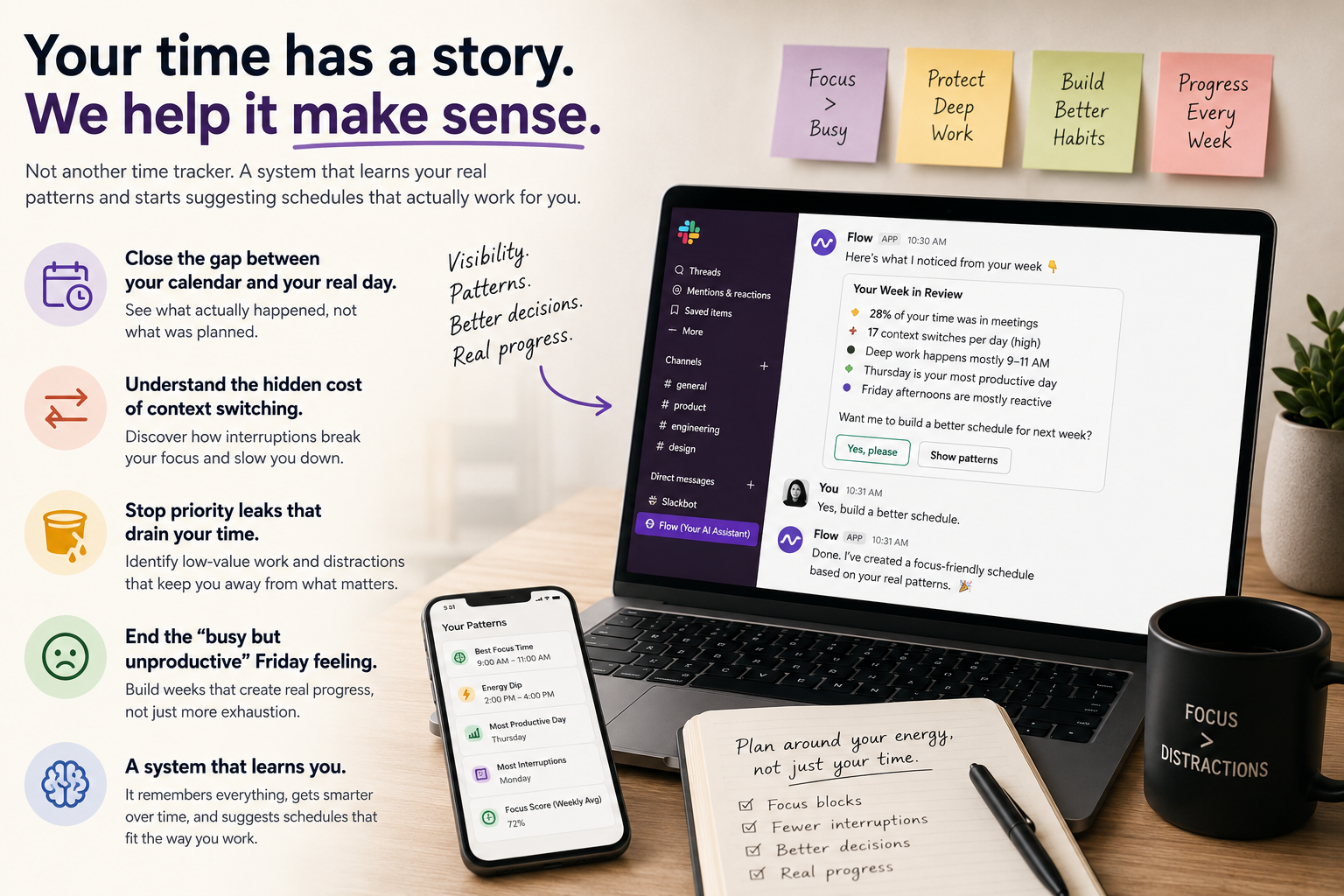
This week we talked about the gap between your calendar and your real day. The hidden cost of context switching. Priority leaks. The strange feeling of ending Friday exhausted but unsure what actually moved forward.
All of it pointed to one question:
Do we really understand where our time goes?
The Calendar Problem Nobody Talks About
Open your calendar for a moment.
You’ll probably see meetings, deadlines, work blocks, reminders, and scheduled tasks. On paper, everything looks organized.
But your real day rarely follows the calendar.
A 30-minute meeting turns into an hour. A quick Slack message becomes three conversations. One interruption breaks your focus for the next 20 minutes. Urgent work replaces important work.
By evening, your day looks completely different from what you planned.
And then tomorrow starts. A new schedule. New plans. The cycle repeats.
Most productivity systems never ask:
- What interrupted your focus?
- What work drained your energy?
- Which tasks consistently get postponed?
- When are you naturally most productive?
- What patterns repeat every week?
Because most systems only track time. They don't understand behavior.
The Hidden Cost of Context Switching
Modern work isn't just work anymore.
It's:
- Slack notifications
- Meetings
- Context switching
- Urgent requests
- Unexpected tasks
You might spend eight hours working and still feel:
"I was busy all day... but what actually got done?"
That feeling isn't laziness.
Often, it means your attention was fragmented. Your brain kept switching contexts instead of staying in deep focus.
The cost isn't only lost minutes. It's lost momentum.
The Difference Between Tracking Time and Understanding Time
Most tools answer:
How long did you work?
But a better question might be:
Why did your work happen the way it did?
Because time alone doesn't explain productivity. Patterns do.
Imagine knowing:
- You focus best before noon
- Meetings after lunch reduce output
- Certain tasks always get delayed
- Deep work drops after too many interruptions
- Your Fridays become reactive instead of strategic
That changes scheduling completely.
Now you're not guessing. You're designing around reality.
The Missing Layer: Memory
What if productivity systems remembered?
Not just completed tasks. Not just hours logged.
But patterns. Behavior. Energy. Attention.
What if your schedule could learn:
- How you actually work
- When you enter flow state
- What consistently breaks focus
- Which work creates resistance
- What your productive weeks have in common
Over time, schedules would stop becoming static plans.
They would become adaptive systems.
We're Building Something Around This Idea
We've spent time thinking about a simple observation:
People don't need another time tracker.
Most already know they're busy.
The problem is understanding:
- What consumed attention
- Where productivity leaked
- What patterns repeat every week
- How work habits evolve over time
So we've been building something different.
Not another to-do list. Not another dashboard. Not another system asking you to manually organize everything.
A system designed to learn.
One that lives where people already work. Inside Slack.
You talk naturally. It remembers. It recognizes patterns. And over time, it starts suggesting schedules built around how you actually operate.
The Future of Productivity Might Be Personal
For years, productivity advice has focused on universal rules:
- Wake up earlier
- Plan better
- Use more tools
- Follow stricter routines
But people work differently.
The future may not be one perfect system for everyone.
It may be systems that learn individuals.
Systems that understand:
- Your attention patterns
- Your energy cycles
- Your work behavior
- Your recurring mistakes
Because productivity isn't only about managing time.
It's about understanding yourself.
Final Thought
Maybe the biggest productivity problem isn't poor planning.
Maybe it's that our systems forget everything.
Every week starts from zero. Every mistake repeats. Every insight disappears.
What changes when your schedule remembers?
That might be the more important question.