AI for Inbound Leads: Who Needs It and Who Doesn’t

AI for Inbound Leads: Who Needs It and Who Doesn't
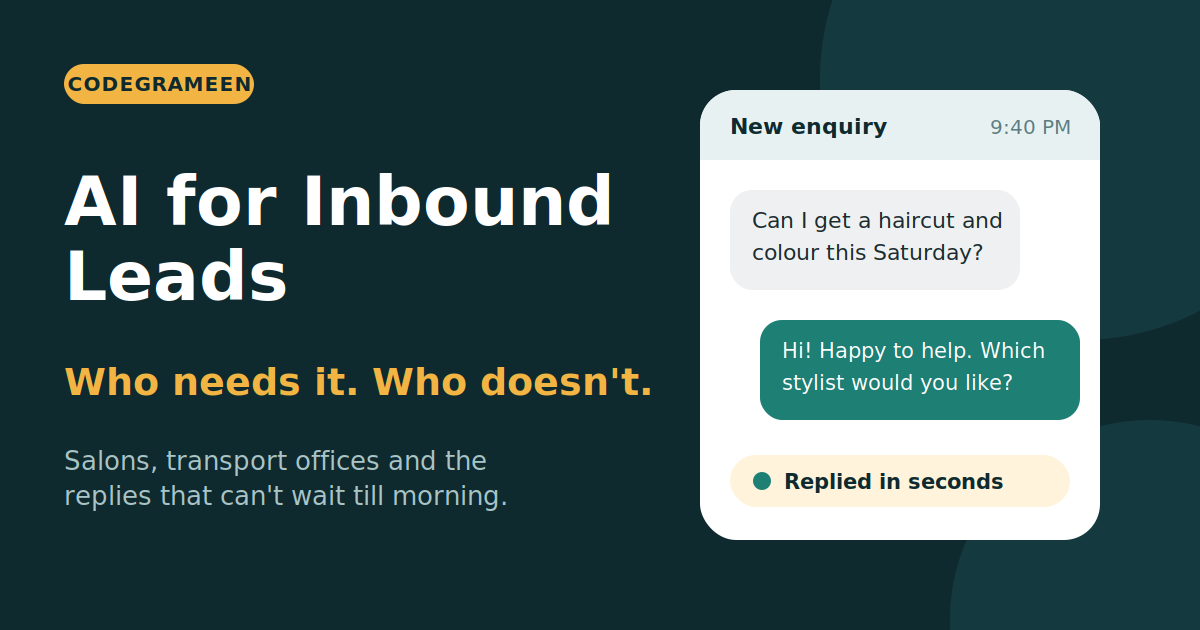
The enquiry that came in at 9:40 p.m.
A woman messages a salon asking if she can get a haircut and colour this Saturday. The owner is closing up, hands still smelling of developer. She'll reply in the morning.
By morning, the woman has booked somewhere else.
Nothing went wrong at the salon. The work was good. The owner was just busy doing the work. That's how most inbound leads get lost: not through bad service, but through slow replies.
The same thing happens at a transport services office. Someone asks for a quote to move goods from one city to another. The person who handles quotes is on the road, on a call, or asleep. The lead waits. Then it goes cold.
We recently recorded a short demo of an AI agent handling exactly these situations: one flow for a salon, one for a transport services office. They are basic flows. But they raise a question worth answering properly: which businesses should hand inbound leads to AI, and which shouldn't?
Why speed matters more than most owners think
Someone who sends an enquiry is usually comparing a few options at the same moment. The first one to reply with something useful often gets the conversation.
There is real research behind this. A well-known 2007 study by James Oldroyd and InsideSales.com looked at three years of data and found that contacting a web lead within 5 minutes, instead of 30, made a huge difference to the odds of reaching the person and of qualifying them (summary on CustomerThink).
| What was measured | Odds with a 5-minute response vs. 30 minutes |
|---|---|
| Making contact with the lead | 100 times higher |
| Qualifying the lead | 21 times higher |
Source: Oldroyd / InsideSales.com lead response study, as reported by CustomerThink and Search Influence.
The second finding is just as telling. In a follow-up audit, Harvard Business Review researchers sent a test lead to 2,241 US companies and timed the replies (HBR article citation, "The Short Life of Online Sales Leads").
| Response time | Share of companies |
|---|---|
| Within 1 hour | 37% |
| Between 1 and 24 hours | 16% |
| More than 24 hours | 24% |
| Never replied | 23% |
Among companies that did reply within 30 days, the average wait was 42 hours. Figures as quoted from the HBR report on Vivocha's blog.
A fair caveat: these studies are about web leads handled by sales teams in the US, mostly by phone, and they are more than a decade old. A salon booking or a transport quote is a different kind of enquiry. Treat the numbers as a direction, not a promise. The direction is clear, though: slow replies cost leads, and most businesses are slower than they think.
[ADD PROOF: your own response-time numbers from a client or your own business, if you have them. They will be more convincing than any study.]
What an AI agent actually does with an inbound lead
Forget the chatbot that says "Sorry, I didn't understand that." A good lead-handling agent does a small number of things well:
- Replies right away, in plain language, in the channel the customer already used.
- Asks the questions you would ask: what service, what date, what route, how many items.
- Answers the repeat questions: prices, timings, location, what's included.
- Captures the details in a clean format so nobody has to ask twice.
- Hands over to a human when the conversation needs one.
In our demo, the salon flow [ADD: what the salon flow does, e.g. collects the service and preferred slot, answers price questions, passes the booking to the owner]. The transport office flow [ADD: what the transport flow does, e.g. collects pickup, drop, load type and date, then prepares the quote request for the team].
An agent isn't there to replace the person who closes the deal. It's there so that person walks into a conversation that's already warm.
Who should use it
AI lead handling works best when your enquiries look alike. These are the businesses where we'd say yes.
1. Businesses where the same questions come up every day
Salons, groomers, car detailers, clinics, tutoring centres, transport and logistics offices. If you've typed "Our prices start at..." fifty times this month, an agent can do it for you.
2. Businesses where the owner is also the one doing the work
If replying means putting down the scissors or stopping the truck, you're losing leads to your own workload.
3. Businesses that get enquiries outside working hours
Evenings, weekends, early mornings. This is where many leads sit unanswered.
4. Businesses with a clear next step
A booking, a quote request, a site visit, a callback. The agent's job is to move the person to that step.
When it makes sense
Timing matters as much as business type. It's usually a good moment when:
- Enough enquiries come in that some are slipping through.
- You already know what a good lead looks like and what you need to ask.
- You have somewhere to put the captured details, even a simple sheet or CRM.
- Someone on your team can pick up the handover quickly.
If you're not yet getting regular enquiries, fix that first. Automation can't create demand. It only stops you wasting what you already have.
Who should not use it (yet)
We'd rather tell you this now than after you've spent money.
1. Businesses where every enquiry is unique and high-stakes
Complex enterprise deals, bespoke legal work, anything where the first conversation needs real judgement. An agent can still log the enquiry, but it shouldn't lead the discussion.
2. Businesses with no clear process behind the enquiry
If your own team gives different answers on pricing or availability, the agent will just repeat the confusion faster. Sort out the answers first.
3. Businesses with very low enquiry volume
If you get a handful of leads a month, you can reply yourself, and you probably should. Personal attention at that scale is an advantage.
4. Businesses where trust is built through a human voice from the first message
Some customers, in some trades, simply want to speak to the owner. If that's your market, use AI for the background work, not the front door.
5. Businesses that won't follow up on what the agent captures
This is the most common failure. An agent can collect a perfect lead, but if nobody calls back, you've built a faster way to ignore people.
| Your situation | Good fit for an AI agent? | Why |
|---|---|---|
| Salon, groomer or detailer with daily repeat questions | Yes | Same questions, clear booking step, owner is busy working |
| Transport or logistics office collecting quote details | Yes | Fixed set of details to collect, quotes often requested after hours |
| Clinic or tutoring centre with appointment requests | Yes, with care | Good for booking and FAQs; hand over anything personal or sensitive |
| Custom, high-value deals with long sales cycles | Partly | Useful for logging and first reply; a human should lead the conversation |
| Very few enquiries per month | Not yet | You can reply personally; build demand first |
| No agreed pricing, process or follow-up owner | Not yet | Fix the process first, then automate it |
What we learned building the flows
- The handover rule is the most important design decision. When the agent stops and a human steps in matters more than how clever the agent sounds.
- Short beats smart. Customers want a quick, clear reply, not a paragraph.
- Start with one flow. Salon bookings and transport quotes are different jobs. Trying to cover everything on day one makes both worse.
[ADD PROOF: any specific mistake or surprise from building or testing these two flows. Honest lessons make this section stronger.]
A practical takeaway you can use today
Before you think about any tool, spend ten minutes on this. Open your last 20 enquiries and fill in the table.
| Question | How many of 20? |
|---|---|
| Got a reply within one hour | ____ |
| Asked the same three or four questions as other enquiries | ____ |
| Arrived outside working hours | ____ |
| Never got a reply at all | ____ |
If most were slow, repetitive, or after hours, you have a good case for automation. If not, you may just need a better routine, and that costs nothing.
Want a second opinion?
If you run a salon, a transport office, or any small business where leads wait too long, we're happy to look at your enquiry flow and tell you honestly whether AI would help or whether you're better off without it. You can reach us at codegrameen.com.
Key takeaways
- Slow replies lose leads, even when the service is good.
- Research on web leads shows odds of contact and qualification fall sharply within minutes, and many companies reply slowly or not at all.
- AI works best where enquiries are repetitive, frequent, and lead to a clear next step.
- It's a poor fit for one-off, high-stakes deals or businesses with very few enquiries.
- Decide the human handover point before you build anything.
- An agent only helps if someone follows up on what it captures.
Sources
- Oldroyd, McElheran and Elkington, "The Short Life of Online Sales Leads," Harvard Business Review, 2011 (BYU ScholarsArchive record)
- CustomerThink: Are Your Lead Response Practices Costing You Sales?
- Search Influence: Internet Form Response Times
- Vivocha: The Short Life of Online Sales Leads (quotes the HBR audit)
Related articles
Why Google Reviews Matter, and How AI + WhatsApp Can Automate Them
This post covers why Google reviews matter, what the data says, and how a simple AI and WhatsApp system can handle the three jobs that most…
Ecommerce Order Automation with n8n and HubSpot
Ecommerce Order Automation with n8n and HubSpot Picture an ordinary Tuesday at a small online shop. An order comes in. Someone has to op…