Why Google Reviews Matter, and How AI + WhatsApp Can Automate Them

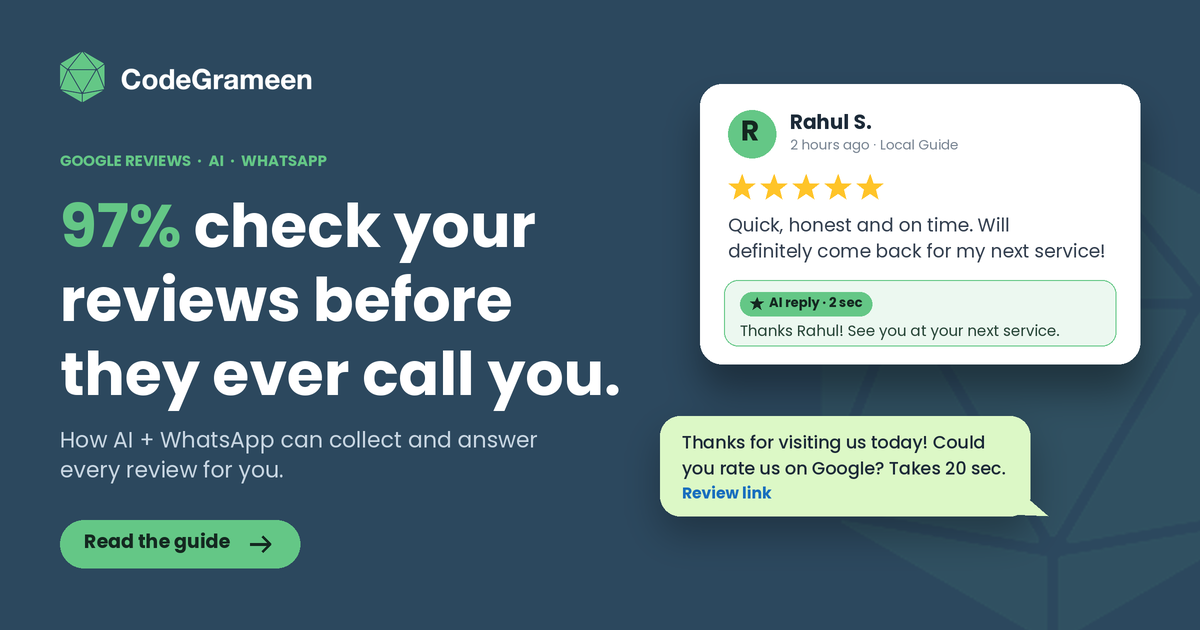
Why Google Reviews Matter, and How AI + WhatsApp Can Automate Them
By Manoj, Founder, CodeGrameen AI Solutions · Published 28 October 2026
Before a customer calls you, visits you or messages you, they have usually already checked your Google rating. Reviews are now the first impression of almost every local business. Yet most owners collect them randomly, reply to them late (or never), and forget the happy customers who would happily come back.
This post covers why Google reviews matter, what the data says, and how a simple AI and WhatsApp system can handle the three jobs that most businesses neglect: asking for reviews, replying to every review, and following up for the next service.
Key takeaways
- Reviews influence both who sees you (local ranking) and who chooses you (trust).
- Freshness matters: a steady flow of new reviews beats a big pile of old ones.
- Replying to reviews is part of your reputation, and Google itself recommends it.
- WhatsApp is where Indian customers already are, so it is the easiest channel to ask on.
- Automation must stay inside the rules: ask everyone, offer no incentives, and get opt-in first.
Why Google reviews matter
1. Almost every customer reads them
BrightLocal's Local Consumer Review Survey 2026 (1,002 US adults, published February 2026) found that 97% of consumers read reviews for local businesses, and the average person checks around six different review sites. A summary of the same survey by PinMeTo notes that the share of people who always read reviews rose from 29% to 41% in a year, and the share who will only use businesses rated 4.5 stars or higher rose from 17% to 31%.
The survey is US-based, but the behaviour it describes (check the rating, scan recent reviews, then decide) is the same for a salon in Gurugram or a garage in Calgary.
| What consumers do | Figure | Source |
|---|---|---|
| Read reviews for local businesses | 97% | BrightLocal 2026 |
| Always read reviews (up from 29% the year before) | 41% | PinMeTo summary of BrightLocal |
| Only use businesses rated 4.5 stars or higher (up from 17%) | 31% | PinMeTo summary of BrightLocal |
| More likely to use a business after reading positive reviews | 85% | PinMeTo summary of BrightLocal |
2. Google uses reviews to decide who shows up
Google's own help page, How to improve your local ranking on Google, says local results are based mainly on relevance, distance and prominence. Under prominence, Google states that review count and review score factor into local ranking, and that more reviews and positive ratings can improve it. The same page recommends replying to reviews.
Third-party studies put the weight of review signals at roughly 15 to 20 percent of local ranking factors (Zoho Reputation Pulse). Treat that as an industry estimate, since Google does not publish exact weights.
3. What "enough" reviews looks like depends on your industry
Review counts of top-ranking local businesses vary a lot by category. These are averages for businesses ranking at the top of the local pack in the US, so use them as a rough benchmark of what competitors have, not as a target Google sets:
| Business type | Avg. Google reviews of top-ranking businesses |
|---|---|
| Roofing contractor | ~79 |
| Plumbing | ~215 |
| HVAC contractor | ~244 |
| Pest control | ~265 |
| Dentist | ~346 |
Source: WiserNotify, Google Review Statistics.
4. Reviews also feed how people find you now
BrightLocal's 2026 data, as reported by Digital Applied, shows the share of consumers using AI tools to discover local businesses jumping from 6% to 45% in a year. People are asking AI assistants for recommendations as well as typing into Google. A business with fresh, detailed, well-answered reviews has more public evidence to be recommended from.
Why most businesses fail at reviews
It is rarely a lack of happy customers. It is a lack of process:
- Nobody asks. Happy customers rarely leave a review unless reminded.
- The ask happens at the wrong time, or depends on a staff member remembering.
- Replies are late or generic. Reviews pile up unanswered for weeks.
- There is no follow-up. After the job is done, the relationship goes quiet until the customer needs someone again, and by then they may have found someone else.
These are repetitive, rule-based tasks, which is exactly what automation does well.
The AI-powered review system: three jobs
Job 1: Automatically ask for the review on WhatsApp
In India, WhatsApp is usually the channel a customer reads first. The flow looks like this:
- A job is marked complete in your CRM, billing tool or a simple sheet.
- After a sensible delay (for example, the next day), an automation sends a short, friendly WhatsApp message thanking the customer.
- The message includes your Google review link. Google lets you copy a review link or QR code from your Business Profile (Google's guide to getting more reviews).
- If the customer does not respond, one polite reminder goes out a few days later, then the automation stops.
Job 2: Reply to every review with AI, with a human in the loop
Google tells businesses that replying shows customers their feedback matters, and that replies are public. AI can draft replies in seconds, using the reviewer's name, the service they mention and your tone of voice.
A practical setup:
| Review type | What the AI does | Who approves |
|---|---|---|
| 4 to 5 stars | Drafts a specific thank-you that references what the customer said | Optional quick approval, or auto-post once you trust the tone |
| 3 stars | Drafts a reply that acknowledges the gap and invites them to talk | Owner or manager approves |
| 1 to 2 stars | Alerts the owner instantly with a suggested calm, factual reply | Always a human |
Avoid copy-paste replies. The PinMeTo summary of BrightLocal's data reports that about half of consumers reject canned responses, so the AI should be prompted to use details from each review.
Job 3: Follow up for the next service
This is where reviews turn into revenue. Once the service is done, the system can schedule the next touchpoint based on the service type:
- A car service reminder after the usual interval.
- A salon or clinic check-in before the next appointment is due.
- A seasonal reminder for AC servicing, pest control or annual maintenance.
- A short "how did we do?" message that opens a conversation instead of ending one.
Each follow-up is a WhatsApp template, personalised with the customer's name and last service, and sent only to customers who opted in.
Staying inside the rules
Automation makes it easy to cross a line without noticing. Three rules matter most.
Do not offer incentives
Google states that offering incentives such as discounts in exchange for a review is strictly prohibited (Google Business Profile Help).
Do not gate reviews
Review gating means screening customers first and sending the Google link only to the happy ones. Guidance from Fit Small Business warns that this selective approach recreates what Google prohibits, and recommends giving every genuine customer the same opportunity to leave feedback. Send the same neutral ask to everyone. The same article notes Google said it blocked or removed more than 292 million policy-violating reviews in 2025, so enforcement is real.
Get opt-in before messaging on WhatsApp
Meta's documentation, Get opt-in for WhatsApp, says businesses must obtain opt-in before messaging people on WhatsApp, must offer clear opt-out, and should watch their quality rating. Capture consent at billing, on a form or in an earlier chat, and honour every opt-out.
Also note that fake reviews and certain incentivised reviews are covered by the US FTC's consumer review rule, which took effect on 21 October 2024 (Durable and Fit Small Business both summarise it). If you serve US customers, keep your process clean. This is general information, not legal advice.
See it in action
We made a short video showing how WhatsApp can be automated to collect reviews and feedback from customers:
What to measure
| Metric | Why it matters |
|---|---|
| New reviews per month | Shows whether the flow is producing steady, recent reviews |
| Request-to-review rate | Tells you if the message, timing or link needs work |
| Reply rate and reply time | Aim for every review answered within a day or two |
| Repeat bookings from follow-ups | Connects the system to revenue |
| Opt-outs and WhatsApp quality rating | An early warning that you are messaging too much |
Where to start
- Claim and complete your Google Business Profile, and copy your review link.
- Add opt-in to your billing or booking process.
- Send one neutral WhatsApp review request to every customer after each job.
- Reply to every review, starting with a clear tone-of-voice guide for the AI.
- Add a service-reminder follow-up for your most repeatable service.
You can build this yourself with a WhatsApp Business API provider and a workflow tool, or let a team set it up and maintain it. At CodeGrameen, we build WhatsApp automation, AI agents and n8n workflows for businesses in India and abroad. If you would like this running on your Google Business Profile, get in touch.
Sources and further reading
- BrightLocal: Local Consumer Review Survey 2026
- PinMeTo: Review survey 2026 summary
- Google Business Profile Help: How to improve your local ranking on Google
- Google Business Profile Help: Get more reviews
- Meta for Developers: Get opt-in for WhatsApp
- Fit Small Business: How to ask for Google reviews without crossing Google's rules
- Zoho Reputation Pulse: Why Google Business Profile reviews matter in 2026
- WiserNotify: Google review statistics
- Digital Applied: Online review statistics 2026
- Durable: Are Google reviews really that important for small businesses?
Related articles
AI for Inbound Leads: Who Needs It and Who Doesn’t
Slow replies lose leads, even when the service is good. AI works best where enquiries are repetitive, frequent, and lead to a clear next s…
Ecommerce Order Automation with n8n and HubSpot
Ecommerce Order Automation with n8n and HubSpot Picture an ordinary Tuesday at a small online shop. An order comes in. Someone has to op…